Welcome to my blog - a diary about living with donkeys, notes about care, my training sessions and the absolute pleasure of donkey companionship.


Leave a comment! Just click on Comments at the bottom of each post and a box will appear. If you have a question, I always respond!


Showing posts with label Health. Show all posts

Saturday, March 31, 2018

Part two: More about Siog

There are some things I didn't mention in my post about Siog and her puzzling displays of discomfort.

While the acupuncture is helping her overall health, I don't think it's really "the thing" that is solving whatever is ailing her.  I didn't mention that she has bouts of liquid manure ... not diarrhea, just brown liquid sometimes.  Hmmm ... this points to digestive issues.

Ulcers cause belly ache and with belly ache, you don't feel like eating.  A donkey off her feed is a red flag alert!  And I would immediately take action.  I have a list of things I try right away and if nothing works, I call the vet. But that's for another post.

All this to say that I don't think Siog is suffering from ulcers, at least not stomach ulcers.  Her appetite is nothing short of amazing - I have never known her to be off her feed, in fact, she gains weight SO easily, I have to be really careful with her.


see those fat bulges?


However she has been treated with Gastroguard just to be sure, and then with a generic brand that also has the amino acid L-glutamine in it. L-glutamine works on the hind gut and hind gut digestive problems are different from stomach digestive problems.

A friend pointed me to these products: www.healthyhorses.ca 
and after trying numerous supplements added to her morning mash, or  in "extra" little mashes throughout the day, I think these are the very best so far.  They support digestive health in the stomach and also in the hind gut. Read about them!

But, we're not out of the woods yet. Siog has had the intensive round of all 3 products, then I back her off and if/ when I see her symptoms appear, I reintroduce the supplements.  She is on the top dressing granular supplement every day though.  And this morning, she was in a real snit, very unsettled and grumpy and chasing poor Rose ... so this will be a day to add the paste and the amino acids back in.  It's so trial and error, I doubt we'll ever home free with this gal.  But I watch her like a hawk and do what I can.

And one final note:  the hemming and hawing over whether her so called "displays" are physical or emotional? That's the 64 dollar question (remember that expression?)   She is a very emotional little donkey, no doubt about it, very annoyed when I work with one of the others, very annoyed if I walk by without asking to perform one of her many splendid behaviours, whimpering and watching me constantly! So ... I think it's both ... something's bugging her.  The way to help, I think, is offering her as much physical AND mental support as I can!


Thursday, March 29, 2018

Siog, puzzling conditions and acupuncture

I have promised to write about Siog (She-OH-g) She is my youngest donkey and will be 11 this summer (who can believe it?)  She came to live with me from a farm on Pender island - her birth place, when she was 3 years old. her owner told me she was "very alpha," which didn't bother me in the least but whatever the term, she is certainly a character and I have to say she has been my teacher.

You see that look?  Well, her eyes follow me everywhere, she whimpers like a dog, she is smart as a tack, curious and loves clicker training!  Still, she has her antics ... such as coming to a complete dead STOP on our walks, refusing to walk through the gate when we (finally) get back and her puzzling displays of physical disomfort.

I have been keeping notes on her outward signs of discomfort for, well, years now!  I don't think there is anything terribly wrong, this after years of trial and error supplements, diet changes, consultations with various vets, ulcer treatments, fecal floats and panels, medical check-ups and simply gazing into those eyes and asking her questions.

So what does the discomfort look like?  Biting her flank (either side) pinning her ears, chasing the other donkeys, irritable with the other donkeys, sometimes pawing, occasionally a roll or two and always, always food calms her down. Sounds like colic, doesn't it?  But it's not. It's stagnant liver chi, it's being a jenny, it's attitude, it's possibly digestive (as in bloating, cramps, hind gut acididosis ...) all of the above or none of the above.

It's NOT my worst nightmares of enterolith, pancreatitis, ovarian tumors ... I don't think so anyway.
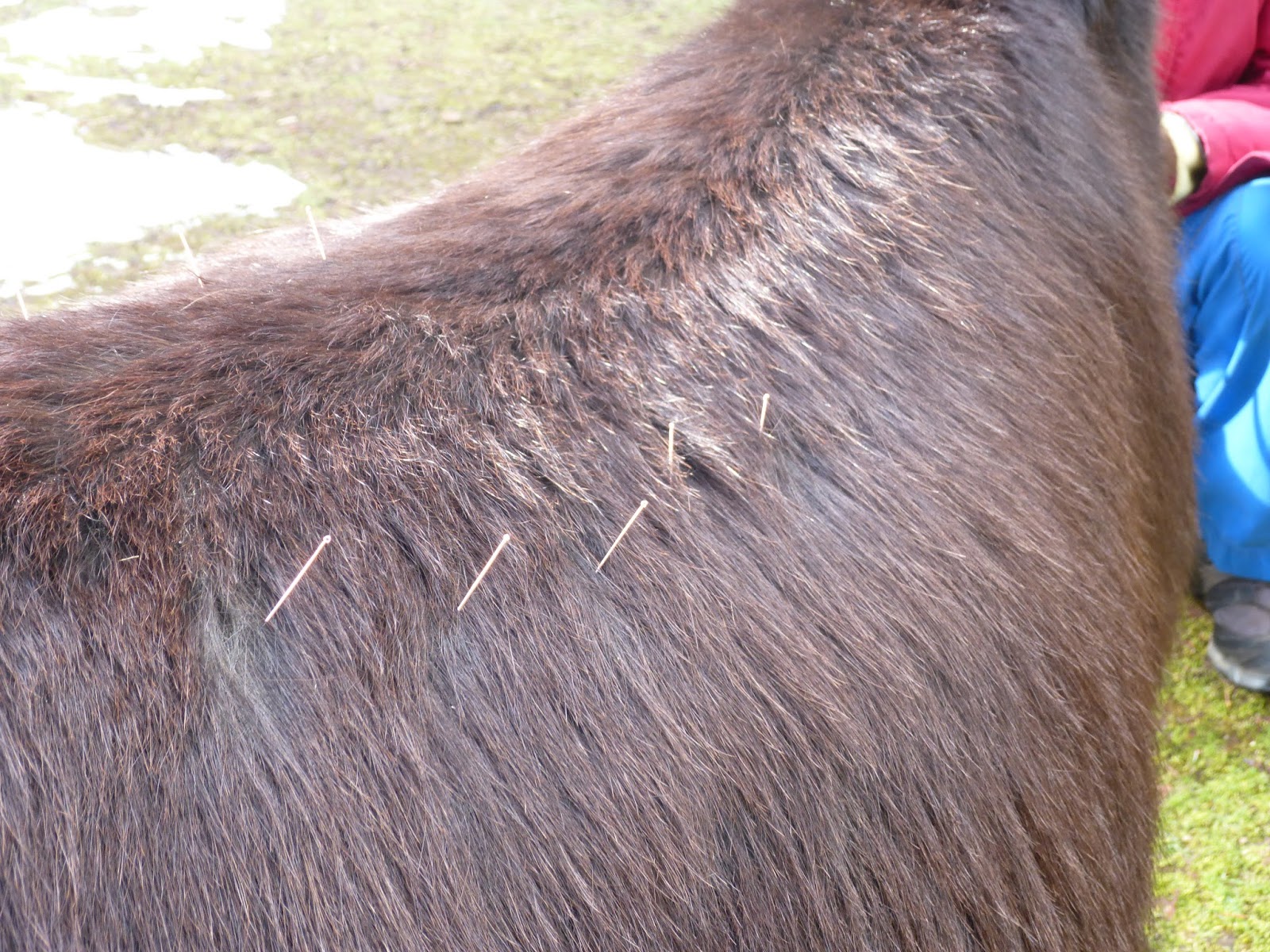
So now we are trying acupuncture and it seems to help her ... a lot! She has had about 5 treatments from our very skilled vet.

One of the things I have noticed about Siog is that she hates to touched on her back, doesn't like to be groomed and often stands camped out with her hind legs out at an angle. Like this:


And the acupuncture treatments have helped with much of this. Siog is always at liberty during the treatments, free to walk away and she never does - and it takes awhile too before the copper needles are ready to pop out.


For more info, I just read this interesting article about acupuncture and equine:

Siog always seems so calm after her treatments, so reading the signs, I'd say they are helping her!

"zzzzzzz ..."


Thursday, October 6, 2016

Fall again and thoughts about donkey "clothing!"

Fall descended upon us so quickly this year!  I love Fall but the rains have begun with intensity already ... and that part, I don't love!  The ground is already soggy and will stay that way until it gets cold enough to freeze.  That doesn't always happen on the west coast.  Some winters just stay wet and soggy.

This can be a real problem for donkey hooves.  While my donkeys have a lovely barn and dry breezeway area, I never lock them in at night.  I do shut the big metal gate to their spacious barn paddock and I do feed indoors on dry footing.  However, it's important for them to move around, so I encourage that.

I'm not big on "clothing" ... rain sheets,blankets, etc.  Healthy donkeys shouldn't need the added protection.  But I do have rain sheets and fleece liners for everybody just in case.  I have found that if it has been raining for a few days and the donkeys are reluctant to leave the barn, a rain sheet offers them a bit more encouragement and they will readily come out for a short walk.


I'm cautious though about not wanting to spread any kind of skin ailment under a rain sheet (the perfect environment!) - rain rot or ringworm will go awol under a raincoat!  And I only put one on if their hair is dry, i.e. not over top of wet bodies.

I'm always concerned about hoof health once the ground becomes saturated.   Frogs, which are supposed to be weight-bearing, wash away and hooves become spongy instead of hard, as they are during summer months.

Out comes my spray bottle of apple cider vinegar and I use this a couple of times per week after cleaning out hooves in the evening.  I also keep a mix of calendula oil + tea tree oil in a bottle.  This is great to apply to keep thrush at bay or for any bruising or abscess.

Over the years I have tried numerous hoof remedies.  Now I only use these, plus my homemade remedy posted on the first page, right side. 

Seems there's one donkey in every group that has softer, more sensitive feet and here, that donkey is Rose.  I've written before about trying boots on her, especially if I take her out on our gravel roads.
The boots I had for her though, were made for big dogs (Neopaws.)  And while there are things I like about them, they didn't fit correctly and kept swiveling around and were fussy to do up with a long strap that had to be wrapped and wrapped and wrapped around her fetlock and then tied.

So ... now she has a pair of EasyCare boots made for miniature horses and these seem to fit better.  You can order them here:  https://www.easycareinc.com/our_boots/easyboot_mini/easyboot_mini.aspx

Horse hooves are not as long and narrow as donkey hooves though, so I have been pondering
how comfortable they actually feel.  I also got another pair that the other donkeys can share if need be and they seem to fit Heather and Siog but not Dorrie.

I don't intend that anyone wear boots full time - they are really for road walking and for sore feet if need be.  I have been putting them on Rose's front feet for short periods of time so she can get used to them!


Saturday, July 18, 2015

The broken-shoulder-summer-blog- blues!

Well, well ... I am truly humbled by the suddenness of change ... one minute: fine, next minute on the ground with a broken shoulder, buggered up arm all swollen and bruised!   Prognosis?  It WILL heal
eventually and this screwed up summer will become a distant memory, yes?

The donkeys, my precious jennys - do they understand?  Who knows?  Other donkey folk say yes they do know - I sure hope so because it's a big change for them too.  I can only talk to them across the fence these days.

Siog was with me when I fell and her wariness suggests that she experienced "something" that made her uneasy.  I am trying reassure her.  I did try some target training through the fence but it's too awkward with one hand (even my dominant one.)  So I must settle into the moment and try to organize my thoughts into something creative and productive.

I had to pull out of the studio tour this summer, just when I felt like I was on a roll with new work, but it's okay. There will be another opportunity.

I am blessed to live in this community - the support is tremendous, loving and caring. Likewise my amazing partner who has picked up the slack everywhere - he is a peach!

In the middle of it all, our beloved 10 year old cat Arlo died last weekend - he was diagnosed with cancer 4 months ago and thus began his steady decline.  We were grateful that his life ended peacefully at home ... at least.


I'll end this post here - with my tribute to a great feline friend.  Gentle summer greetings to you all.

Saturday, September 6, 2014

Stung!

Argh - the wasps are bad this year, cruising low, looking for protein.  Yesterday one bit me on my finger and I react very badly.  So I grabbed my tube of Afterbite and downed two Benadryl.  My finger is swollen and sore but manageable.

Last week, I think Siog was attacked, although I didn't witness it - I found her standing all by herself in the barn breezeway with a welt on her neck and two strips of exposed skin where the hair had been rubbed off.  Within an hour, neck swelled to the size of a tennis ball and has since scabbed in several places.  Poor thing!

Tonight, I had just put some barley straw in the outside feed trough, when Dorrie suddenly started snorting and blowing and rubbing her nose violently!  So violently, in fact, that she caused it to bleed!
I grabbed my tube of Apis  http://elixirs.com/apis.cfm  that I keep in the barn and slid 4 small pills in her lower lip to dissolve.

Then I ran a few cotton compress pads under cold water and washed of the blood, haltered her and took her out to graze on some short grass until she calmed down ... took awhile!

I always keep a supply of Apis and Arnica: 
http://www.britishhomeopathic.org/bha-charity/how-we-can-help/medicine-a-z/arnica-montana/
in the barn and use both on myself and the donkeys.  They won't cause any harm, and can be extremely helpful!


Monday, August 25, 2014

Donkey Radar

The first morning of the annual studio tour, everything was ready to welcome art loving visitors.  My studio was cleaned, art work beautifully displayed, signs up, even the outhouse shone!  That's when I noticed that Dorica wasn't herself.  I can tell in a nano-second!

She ate her breakfast but soon lay down and just seemed ... low.  And then she was off her hay, no doubt about it ...OMG!

My first diagnostic check is to put my ear to her hind gut, both sides.  I didn't hear much in the way of gurgling and that's not good.  I checked her teeth in case something in her mouth was causing pain ... nope, nothing obvious.

There are several different kinds of colic, "colic" being the name I call whatever condition puts a donkey off her feed.  Spasmotic colic should pass, walking can help, as can a touch of Banamine if necessary.  Eating some wettish grass (not too much) or a mash can help also.

Sand colic can happen if the donkey ingests too much sand if the pastures are very overgrazed, like mine are.  The sand accumulates in the gut and doesn't pass through the digestive system.  A prolonged does of psyillium in a mash given every other day can help flush the sand out, but I wouldn't embark on this without checking with a vet.  Sand can sometimes be heard in the gut if you use a stethoscope.  The vet may also want to do a nasal-gastric tube to flush out as much sand as possible and that means sedation ... all to be avoided unless absolutely  necessary, in my opinion!

But if it is an impaction, that's serious and not something I can deal with, without the help of a vet.  Pray that it's not the latter!  Exercise can make an impaction worse too, so walking is no help.

I proceeded with Dorrie as if it was a spasmotic colic and I guess it was, as she recovered, thank goodness!  I gave her 0.5 cc of paste Banamine and then a warm water enema, hoping to add some fluid to the "other end."

I brought her to my studio and let her eat some short grass so I could keep an eye on her but Dorrie will NOT pass manure when she's got a halter and lead rope on, so I had to return her to the paddock with the others after awhile.

Eventually, whatever it was, passed thank goodness, and she was back on hay and her own sweet self.  Crisis averted!   It's so important to have what I call "donkey radar" and noticed if your donkey is just not herself.  Given their stoic nature, their condition may be worse than you feared by the time you notice.  If I suspect anything at all, I watch, collect data and then think through my options for diagnosis and treatment.

Wednesday, June 4, 2014

Dental Day

I had heard that a terrific equine dentist was traveling up this way from the mainland and after exchanging a few emails with him, learned that he has all the gear for minis (many vets only have dental apparatus for big horses.)

My regular vet (whom I adore) only does hand floating and has a strange little mouth prop that doesn't allow her to actually look inside the mouth.  It's easier on the donkey for sure, but she has to do everything by feel.  And how far can one feel inside a mini mouth?  Their teeth go way back.

So I thought this would be a great opportunity to have a dental specialist "float" the donkeys and also I really wanted to be able to see inside of Rosie and Heather's mouths as they both chew a bit funny!

So, the vet arrived with his assistant at 7:30 AM and got set up.  He has a chin rest which he hangs from a beam.  First he talks to the donkey and checks out her mouth, then he sedates them with a low dose of Rompum + Detomadine, then he fits the mouth speculum and opens it manually to about 70% so as not to stress the jaw.  Then the donkey's chin goes onto the chin rest - this keeps her head up a bit so he doesn't have to hold it up.  A dozy donkey is likely to lower her head.

He has mini attachments for a cordless drill and sets about grinding off points and hooks.  He decided to abandon the chin rest (hanging) for Dorica. Instead his assistant is holding her head up.  On the extreme left, you can see Forrest watching with some trepidation.  She said she found it "disturbing" and I have to say I agree with her, although I know it was for the best!


Here he is examining Rose - she is 17 now and has a lot of tartar. He left a little rubber finger brush for me to use.


And here is Siog being sedated before the procedure.  She was so wonderful! 


After it was all done, the donkeys were very wobbly, especially Siog.  Siog had sharp hooks on her very last molars on the bottom jaw.  The vet said that a hand float could never have removed them.  Unfortunately he rubbed the gum a tiny bit with the float (which had protective guards) and Siog suffered afterwards.  It was clear she felt lousy and when she refused to eat, I decided to give her 0.5 cc of paste Banamine.

I didn't use to reach for drugs so soon, I was much more of a "wait and see" person!  But the signal to use Banamine for me is if a donkey is off her feed.  Things can go sideways pretty quickly, so I think of a small dose of paste Banamine (Flunixin) the same as taking an Advil.  It can relieve pain and inflammation quite quickly.

This morning everyone is fine and I feel better too!  I think I'd like to learn a bit more and tweak the dental process a bit if possible.  I thought the donkeys were too upset during the procedure.  Poor Heather practically sat down and was pulling away, causing great strain to her poll.  I'm not sure about the chin rest apparatus and would like to find the exact right combo and amount of drugs to use for them.  They seemed more sedated afterwards than during the ordeal!

I really liked this dental vet - he was very kind and very open to suggestions.  He had a great bedside manner with the donkeys and really knows his stuff!


Thursday, April 17, 2014

Straw delivery!

Well I lucked out!  Someone here is starting a straw bale garden and needed 50 bales, so I jumped on board and ordered 50 bales for us too and we split the delivery cost.  Good deal all around.  I usually buy barley straw in September, but this year, as my hay loft is half empty by now, I thought why not get it sooner than later and have it done!  I'll restack what's up there and make room for the straw and then a load of hay in June.

This is 100 bales on the truck - 50 for us!


But for the time being, it has to be stacked here on the covered porch, tucked behind the wisteria:


It will need to be moved up to the hay loft:


But my hay elevator is still in its winter home behind the barn!


This straw is from a dairy farm on Vancouver Island. It's stored in a huge loft above the cows and stays nice and dry.  Last August I bought  2012 straw from this farm and had it tested.  I was so worried that it might be high in sugar and starch but turned out it was pretty perfect  for the donkeys.  If anyone would like a copy of the analysis, leave a comment or send me an email and I'll send you the report.

It is so hard to keep weight off minis!  But now I understand the difference between fat and bulk.  Fat is stored in the neck crest, the saddle area and the rump.  Bulk, which I define as roughage passing through the gut, can make the donkeys look very round (oil drum on legs?) but it's not actually "fat."  

They need this roughage as a protection against the hydrochloric acid which is constantly being produced by the stomach.  The digestive tract needs to be active most of the time.  So straw, which is low in calories, protein and sugar is fantastic added to a basic diet of minimal grass, browse and hay.

Tuesday, April 15, 2014

It's beautiful outside, but ...

Where, oh where are the donkeys?  Expecting to see my little herd basking in Spring's first warmth,
I found them instead way back in the barn!  Huh?  Out they came when I called and then I realized ... MIDGE ATTACK!  Oh, poor donkeys, they were getting eaten alive.

So out came the fly masks with ear protectors and my home-made fly spray (thank you Avon Lady!)
See my recipe to the right of this post.  It works great, although you do have to reapply every few hours for best results.  (I usually give them a spritz about twice a day.)

I use these fly masks during midge season which lasts a few weeks, they look completely ridiculous (imagine a herd of, say 200 donkeys all wearing them!?)  But ears are favorite biting places for midges and they can cause a lot of discomfort and scabs, so I love these masks. 

Before I got them, I tried gently rubbing a few products in donkey ears, but most made their ears too sticky or matted down the hair - I now prefer the masks.

Fooling around with some cardboard!


Rose, you should see yourself - ha!


Proud of those ear extensions - even longer - yay!


Thursday, February 20, 2014

Radar ... aka worry- wartitis!

Do you know the feeling in the pit of your stomach when you just  kind of "sense" that something may be wrong with one of your donkeys?  It's a funny gnawing feeling for me.

Well two days ago, I noticed that Dorica had one eye closed and tearing - probably she got poked by a twig from a salal branch or something in the woods.  No big deal - I applied some saline solution and the next morning it was improved.  Not entirely though and by evening, I decided to apply more saline - carefully, as you don't want to force anything into the eye that may be trying to come out.

Anyway, it wasn't that that was worrying me - I also noticed that she seemed a bit out of sorts - grumpy with the other donkeys and a bit sad.  Perhaps her eye was sore.  But even MORE worrisome is that she isn't drinking very much - typical of her but I couldn't manage to catch her pooping either!  Now Dorrie is very private about these matters - you've got to know your donks, they're all so very different in their habits.


Dorica had a dangerous impaction colic last winter so I watch her like a hawk.  I make sure water buckets are clean and plentiful.  I checked her gums ... hmmm ... a bit on the dry side?  Donkeys are so stoic - all kinds of things could be happening before you realize, so I've developed a kind of radar that seems to have its own internal warning system!  But can I trust it, or am I just a worrier?

I decided to take precautions and do a few things that can't hurt, even if I'm imaging a problem.  I gave her a warm water enema and a warm bran mash.  My vet loves bran mashes - I'm not so sure!  I've read stuff that suggests that it doesn't really work as a laxative after all, but maybe just the superstition that it will, helps! 

So I soaked up 1/2 cup wheat bran in warm water and added 1 or 2 tablespoons of plain applesauce.  At least it gets a little more liquid into her, plus her daily beet pulp/ soy mash at 4:30 should help too.  She's had that twice now and I think that's enough as I have seen her poop (relief!)

I also took her out for some grazing and gave her the choice of a few different kinds of plants.  She particularly loves a wild mint that grows nearby but also gobbled down sword fern, Oregon grape, huckleberry and or course grass!

This morning, Dorrie seems just fine so I decided not to do anything special.  That feeling in the pit of my stomach?  Well, it's still lurking a bit but I think I can talk it into submission ... for now!

Monday, February 17, 2014

New Diet for the Hens

I was given a wonderful little book recently called Fresh Eggs Daily by Lisa Steele.
She's a chicken farmer and also a herbalist and it's this combination that really excites me!  She grows and uses herbs for a wide variety of things - to encourage egg laying, to discourage parasites, to freshen the coop, keep flies away and improve the nutrition and general health of the flock.

I don't have a big stash of dried herbs at the moment, although I do grow quite a variety.  But this is definitely on my list for this year.  Grwo more, dry more!

One thing I have done though is mix up a feed based on what she calls the "Breakfast of Champion Layers!"

While it certainly adds to the cost of the feed, it feels so wonderful to be offering this to my merry band of ten hens. And it will improve the quality of the eggs for sure.

Here's what I mixed up yesterday:

To a big bag of 16% Organic Layer Mash, I added:
  1. Hulled sunflower seeds (Purchased in the wild bird feed department)
  2. Organic whole oats
  3. Cracked corn
  4. Flax seed
  5. Food grade Diatamaceous Earth (personally I would never feed this to mammals but the hens can handle it)
  6. Brewer's yeast
I have a lovely mixed flock made up of  3 Americaunas, 2 Blue Opringtons, 1 Chanticleer, 1 Black Australorpe, 2 Silver Grey Dorkings and 1 Light Brahma.  Here they are enjoying a new batch of feed:


Quite a variety of eggs!


Wednesday, December 11, 2013

Siog- what's going on?

Siog, who turned 6 this past July, cycles frequently.  She seems to come into heat about every 3 1/2 -4 weeks and even when I think it's over, she'll display some sign that it's not.

I've been keeping an eye on her, as she clearly seems to be in some discomfort during her cycles. 
What I notice is that she turns her head and noses or nips at her flank just in front of her stifle.  She seems perpetually hungry and she is grumpy with the other donkeys, suddenly turning on whomever is closest and chasing her away.

Several months ago, I asked my vet about the possibility of an ovarian cyst. She agreed that it was possible but how to find out on a mini?  An ultra sound probe is not possible.

So I turned to an equine nutritionist who practices homeopathy, herbal medicine and kinesiology (and then recommends her own expensive products!)   She said to give Siog Vitamin B6 and also Magnesium Citrate when I see her in discomfort,  which acts as a  anti-spasmodic muscle relaxant. 

This does seem to help but I'm a bit leary of giving too much.  If I see Siog in discomfort, I'll mix up some Timothy hay pellets with warmish water and stir in 1/2 tablespoon of the magnesium citrate.  However this isn't getting to the root of whatever problem she has.  Which seems impossible to actually diagnose, other than observing clinical signs.

Spiking hormones, ovarian cyst, something else?   I may try Chaste Tree Berries - am just worried about mucking around feeding her stuff  when I don't really know what's going on!  Any advice out there?

Monday, December 2, 2013

Brrrrr .....!

Getting colder and overnight lows are expected to dip to -7C  (or 19F)  Now that's cold for this part of the world and I've added a down vest under my coat! 

Wind, rain and/ or snow make it feel even colder and it's advisable to provide extra fiber in the form of low sugar hay or straw as equine stay warmer by digesting feed in their hind guts.  During the days, I am currently just feeding the regular amounts but it's overnight that I think I need to offer something extra.

So I just started filling four extra hay bags each with 0.5 - 1 lbs. hay.  Now, at about 9-9:30 PM,  I'm putting out eight hay bags in different locations in the barn and breezeway (for a total of 1.5 - 2 lbs of hay each) and also leaving 1 flake of barley straw divided in the feed troughs.  Hopefully this will last a wee bit longer!

They are also getting generous portions of soaked FiberMax pellets - 40% beet pulp + 60% soy bean hulls.  To this I add 1 - 2 teaspoons of plain white salt.

Oh and numerous buckets of warmish water!


Sunday, November 24, 2013

Feeding angst

Since building the feed troughs, I have experimented with keeping some straw in front of the donkeys all day - cut out a hay feeding so they are only getting a hay bag first thing in the AM and last thing at night, around 9 PM and then lots of barley straw (not weighed) throughout the day.  Very limited grazing.

But, my oh my - they are HUGE!  Am I am freaking out!  They will eat anything and everything, including the fences and I really don't like how they look - very wide, kind of like oil drums on legs.  Borderline obese, even!  I'm even embarrassed to post photos of them!  A bit of white line separation going on too.  Awckgh@#^)!!!!

So this past Friday, I gathered samples from 12 bales of barley straw and sent it off to a lab.  There is SO much controversy about feeding straw - many people on the equine nutrition circuit suggest that:
 a) it might be really high in starch and sugars and b) straw in North America might be quite different to what is called straw in the UK.  I really don't know so I figure I'd better have it analyzed.

I would love to be able to feed free-choice - many people do - but these minis are a challenge, gaining weigh so quickly.  I confess that I've never really understood how to feed free choice - I mean, how much would you put out for them at one time? And doesn't this contradict feeding a % of their body weight?  My gang would do well on a maximum of 4 lbs. each mixed hay/ straw per day (even that might be too much if you were feeding by optimum body weight) - but they would gladly eat waaaaay more than that, if it were offered.  And I'm afraid I have been offering way more to see how they would do on straw if it is always there for them.

In the meantime though, I'm afraid I am cutting back their feed somewhat - not withholding food, that would be wrong, but trickle feeding smaller portions frequently and cutting back on the amount of straw, except overnight, when I am really generous.

Increasing their exercise too - they really need jobs to do but it's winter!  In any case, we do "something" every day, a bit of trotting or jumping or walking.  Right now I'm going to halter up Heather and head out for a walk.

Thursday, October 24, 2013

More troughs

The donkeys and I have all become very fond of the outdoor feeding trough we built last July! I still use slow feeder hay bags morning and night but during the day, weather permitting, I put a mix of hay and straw in the trough and they come and go.

I'm not comfortable heaping it in there though, as I am paying close attention to weigh and body condition, so I can't say I'm feeding free choice but it is so regular that I'm hoping their metabolisms are settled into a comfortable place of fairly constant digestion.
They have access to some bush too.

I am really trying to minimize food-related stress - an important thing to notice especially with multiple animals competing for food.  They have a tendency to gobble or bully or over eat.  So by leaving food for them, this settles down.  It has to be the "right" food though - low in protein,  sugars and starch and high in fiber.  Sadly, I have yet to find this "perfect" fiber (hay or straw!) so I am still doing a bit of monitoring and doling out.

Anyway, this post was supposed to be about troughs ... I was so disappointed at the thought of not being able to use the outdoor trough during wet weather that I was searching for solutions.  My first thought was to build a roof over the whole thing - big enough to keep the donkeys dry as well as the hay.  But the ground still might get muddy, rain still might blow in, snow might too!

Solution # 2- re-create the trough inside the barn - but where?  The barn has smallish-stalls and a centre aisle and I need to create something that is not an obstruction or potentially dangerous as donkeys come and go.

Hmmm ... aha!  A solution!  Build four new feed troughs into the corners!


These were simple to make.  We filled in sides and backs with plywood, then simply angled the front boards across a corner and attached PVC pipe along the top with metal strapping.  The ends of the PVC go into uprights or are cut snug at an angle into the  wall, so no sharp edges and no chewing the top rails either!

Three built and one to go - the donkeys love them and they are standing on the dry barn floor while eating too!

Thursday, October 10, 2013

So much "stuff" on line!

There's so much to learn "out there" in cyber space!  A friend told me about the Donkey Welfare Symposium being held next month at UC Davis in California.  If only I could attend ... but wait - they're offering a live, interactive webinar!!!

Now how can I resist that?  But how can I find the time?  My art exhibition gets set up on the 6th - a 6 hour trip from here and SO much to do before then - but ... how can I miss this?

I just registered - I WILL find the time!   Here's the link to the program:

http://donkeywelfaresymposium.homestead.com/

Sunday, October 6, 2013

Balancing Vitamins and Minerals for Donkeys

This has always been a head-scratcher as very little research has been done about which vitamins and minerals donkeys need and how much. So we donkey owners tend to feed horse stuff, adjusting the amounts and hoping for the best.  This is probably dumb!

I offer a mineral block that has selenium in it (I know we are deficient here on the west coast) and I also put out a salt lick plus a wall feeder with loose white salt in it.  The donkeys use all of them ... a bit! So maybe that's enough - after all everybody is healthy.

But, but, but ... lately I've been thinking about the idea of being over fed but under nourished.  The donkeys never seem to reach a level of satisfaction, even though they are being fed LOTS!  Probably too much as they are chubby and that's not good.  So what could be going on?  What are they looking for? 
Munch, munch, munch ...

My friend from The Dancing Donkey blog, has been doing a lot of work on exploring her hay test results and setting up spread sheets to try to determine what the deficiencies are in her hay (and mine too - thank you K!)


Hmm ...  we KNOW that donkeys utilize feed differently than horses (more efficiently) and we know that their feed requirements are less than horses, i.e. they can make use of coarser, lower protein hay than can horses and they can eat scruffy bits of browse and find some value in it.

So now the UK Donkey Sanctuary has developed a vitamin/ mineral pellet for donkeys (yay!) ... that we can't get in Canada (boo ...!)   I have compared the feed tags between the UK-produced pellet and the ones I have been feeding (occasionally) but e-Blogger will only let me paste photos, not text files.

Look up http://drreeds.com/formula2.html   - I feed this pelleted form because I don't need to put it into a wet mash, like you do with powdered supplements.

And here is the one developed especially for donkeys in the UK:
http://www.topspec.com/shop/products/topspec-donkey-forage-balancer/  They don't list ingredients but it's a VERY different product with far fewer ingredients from what the feed tag tells me!

And for us, it looks great because it doesn't contain iron or manganese, both of which this year's hay has in excess, and it has added copper and selenium, both of which are deficient in this batch of hay.

I am considering sending the hay test results and the ingredients list from TopSpec (I have written to them for more info)  to someplace (?) that can custom-make a supplement for me - balancing the deficiencies in my hay and leaving out stuff that it has in excess.  It would be very interesting to see if the donkeys respond to having the "correct" balance of vitamins and minerals by balancing out their body-weight!

Having said all this, Dorrie and I went out for a super walk yesterday - exercise is also a high priority!

Thursday, August 22, 2013

Hay test results

Here are the laboratory test results for the hay I bought this year.  Complicated stuff to interpret! I've edited out the test results for "Dry" - what you're seeing here are the results for "As Fed."  I didn't test for selenium as there's probably none (this area is very deficient) but the donkeys have a mineral block with selenium added and also get a pelleted mineral/ vitamin now and then.

I have to say I am disappointed in the level of non-structural carbohydrate (NSC) which should be 10% or less for donkeys, and I think the Total Digestible Energy should be a lot lower too.   It's pretty high fiber too but all of my donkeys should be able to handle that, given their ages and good teeth. The low protein level is good though, I think!

With our cool, wet Spring, I was hoping the sugar levels would be lower, since the grass was not stressed, but there are SO many factors and most hay growers around here just cut what grows rather than trying to manage pasture.

This will have to be mixed with barley straw in order to provide enough low energy fiber.

Dr. Burden from the UK Donkey Sanctuary has very kindly looked at these results too and given me her educated view on mineral levels and their ratios as well as the other test results - I am hugely appreciative as there's only so much I am able to glean by looking at the numbers!


MIXED GRASS HAY 15 BALES SAMPLED,  DATE SAMPLED: 2013-07-30


PARAMETER:  AS FED

DRY MATTER
Moisture 8.66
Dry Matter 91.34 

PROTEIN
Crude Protein 5.10
Soluble Crude Protein 41.04
ADF-CP 0.15
UIP ( Bypass Protein) 29.48

FIBRES36.99 % Wet Chemistry
Neutral Detergent Fibre 55.01
Total Digestible Nutrients 54.88

MINERALS
Calcium 0.36
Copper 5.61
Phosphorus 0.16
Potassium 0.83
Sulphur 0.13
Magnesium 0.18
Zinc 18.72
Iron 460.34
Manganese 170.90
Sodium 0.21

CALCULATION
NSC 13.24
NFC 20.73
Relative Feed Value 92.79

OTHER
Starch 2.02
Equine Digestible Energy 2  MCal/Kg
Total Sugar 11.2
ESC = 9.10%

Saturday, June 1, 2013

Separation Anxiety

Donkeys can form deep bonds with one another.  I shudder to think of how they must feel when a buddy is sold and suddenly taken away!  And I've been the guilty party over the years, having bought donkeys and re-homed two of them.  Not everyone necessarily gets along though - I've seen donkeys "tolerate" one another without really developing a strong attachment.

Deenah was really bonded with Dorica but neither of them liked poor Ringo, who ended up being third man out, often by himself or trailing along.  But take Dorrie out for a walk and Deenah would go completely nuts.  In my opinion, she did very un-donkey-like things, like trying to go through fences or
jump gates etc.  There was only one paddock I could safely leave her, always with another donkey and food, but she still ran up and down the fence line calling and worrying until we got back.  It was stressful for everyone.

Now Heather seems to be the dependent one.  She has been really bonded to Rose and very upset if Rose was in an adjoining paddock working with me or out for a tiny walk.  But a few days ago, she came into heat at the same time as Siog and now suddenly she can't bear to have Siog out of her sight!

I took Heather out for a little walk yesterday and she didn't want to go very far past the driveway (unlike her!)  I coaxed her a bit then brought her home and before I could get her halter off she galloped away to find Siog.

Siog and I have really enjoyed many walks together and it has been awhile since I've had her out on one.  So last evening, I decided there was time for a stroll before it got dark and off we went.  Siog was energetic and keen and we were out for about 45 minutes.  When we got home, Heather was completely drenched in sweat, like I mean, soaked and hot!  I was really concerned - my partner confirmed that Heather hadn't stopped running the whole time we were gone - even though she was with Rose and Dorica and there was food available.

It was close to feed time, but I didn't want Heather to start eating until she had cooled off a bit, so the four donkeys and I walked the paddocks - around this one, through the gate and along the fence line of another paddock - for about half an hour.  Then I took them back to the barn and hung their nights bags with straw and hay.  Heather was alright by that time and is fine this morning.  Whenever I glance out the window, she is glued to Siog.

This distresses me though and I really hope the antics are due to the fact that she's still in heat (and Siog is also.  I'll have to have a chat with her ...


Tuesday, April 30, 2013

Siog's hoof abscess

Oh it's been a tough week - poor little Siog!  I have been soaking her hoof 3 times a day for 20 minutes each time, in an attempt to encourage her abscess to work its way out.  Finally offered her some paste Banamine as she has been so miserable.

Siog is a master at removing poultices.  Every time I come up with a new and improved way to attach a poultice, she tries to "break her personal best" at removing it ... wizard!

The vet came today and found two spots, made big holes so the pus would drain.  She should feel some relief but she is still limping.  I will continue the hoof soaks through Friday and add some Betadine to the water + Epsom salts.

The vet said it's been the worst year in a long time for hoof abscess problems!  My theory is that the ground never really hardened through the relatively mild winter we had, so hooves absorbed too much moisture, leaving them vulnerable to infection.

I clean every evening but will need to disinfect more frequently, especially when it's wet out.  And I think I'll scrub the disinfectant in with an old toothbrush too to really make sure I'm getting the cracks.

I'm off to do the lunchtime soak - it's a good opportunity to clicker train her!