Back to kindergarten for Siog and lead training ... baby steps and a high rate of reinforcement.
Today I took her on a long walk - about 2 hours - and carried my small click stick with me.
It really worked to have the target stick to focus her and she only stalled once, which is not bad.
She threatened to get stuck a few times on the way back which was uphill for the first half of the walk, but I found she responded well to the target stick. Much better to this than my outstretched hand.
But I know I should be working a bit every day in the paddock or a small space, however the days are filled to the brim with so many Fall tasks like stacking firewood, picking plums, apples, tomatoes, etc. A walk out with a donkey is a real treat!
Wednesday, August 31, 2011

Thursday, August 25, 2011
Trailer loading session
It's so important to teach trailer loading before you need it! In an emergency, you want to know your animals will load easily and a happy animal is a safer animal too.
So this morning, I decided to hook up the trailer and back it into the barn paddock. Dorica has been through this drill before, but the only time Siog was in a trailer was last November when she left her home on Pender Island.
When I brought Deenah home in 2006, it took me 2 hours to load her and since then, she has pretended not to notice a trailer - it isn't a word in her vocabulary! And I have to confess, I haven't used the trailer much, even though I have had the best of intentions.
Today both minis went in and out easily but Deenah wouldn't even consider it. So after some supportive rewards for the minis, I tied them to fence posts and set about teaching Deenah how to load.
This is where clicker training can work miracles! Deenah has been trained to follow a target stick. I haltered Dee and asked her to follow the target and we walked all around the truck and trailer, stopping and starting several times. When we arrived in front of the trailer's open doors, I stepped in and extended the target for Deenah to touch. I didn't ask her to step in yet.
With clicker training, it's important to work in baby steps and not rush things, so I unhooked the lead rope and clicked and rewarded Deenah for staying at the back of the trailer and being interested. Very gradually I held the target stick further inside and she'd crane her neck to touch it. That's just fine.
Eventually she stepped up with her two front feet - click and reward! But I wanted her to feel comfortable and not force her, so when I could see that she wasn't going to step in with her back feet, I snapped on the lead rope and walked her around again.
Back to the doors, step up, step back, click and reward for trying. But now I decided to increase the reward, so I got a big handful of her favorite hay and place it on the trailer floor at the farthest corner. After just a few tries, she stepped in and stood happily munching. Success without any force!
So this morning, I decided to hook up the trailer and back it into the barn paddock. Dorica has been through this drill before, but the only time Siog was in a trailer was last November when she left her home on Pender Island.
 |
| Dorrie stepping in. |
 |
| Dorrie's in! |
When I brought Deenah home in 2006, it took me 2 hours to load her and since then, she has pretended not to notice a trailer - it isn't a word in her vocabulary! And I have to confess, I haven't used the trailer much, even though I have had the best of intentions.
Today both minis went in and out easily but Deenah wouldn't even consider it. So after some supportive rewards for the minis, I tied them to fence posts and set about teaching Deenah how to load.
This is where clicker training can work miracles! Deenah has been trained to follow a target stick. I haltered Dee and asked her to follow the target and we walked all around the truck and trailer, stopping and starting several times. When we arrived in front of the trailer's open doors, I stepped in and extended the target for Deenah to touch. I didn't ask her to step in yet.
With clicker training, it's important to work in baby steps and not rush things, so I unhooked the lead rope and clicked and rewarded Deenah for staying at the back of the trailer and being interested. Very gradually I held the target stick further inside and she'd crane her neck to touch it. That's just fine.
Eventually she stepped up with her two front feet - click and reward! But I wanted her to feel comfortable and not force her, so when I could see that she wasn't going to step in with her back feet, I snapped on the lead rope and walked her around again.
Back to the doors, step up, step back, click and reward for trying. But now I decided to increase the reward, so I got a big handful of her favorite hay and place it on the trailer floor at the farthest corner. After just a few tries, she stepped in and stood happily munching. Success without any force!
 |
| You can see the target stick in the foreground where I left it for the photo. |
Monday, August 22, 2011
Hay!
 |
| Hay truck in the ferry line-up - every strand of hay has to be covered! |
 |
| And here's my pick up with a small load. |
 |
| On the island and backed up to the hay loft. |
 |
| Got this used hay elevator last year - what a huge help it is! |
 |
| Up and into the hay loft - 89 bales in total. |
Friday, August 19, 2011


Tuesday, August 9, 2011

Friday, August 5, 2011
Thoughts about habitat and health
It is so hard to keep the minis slim! They seem to inflate even with very limited grazing. With my recent investigations into carbohydrates and sugars in hay (and straw) I really think these components are to blame for weight gain. Fiber with very little carbs is what they need ... but also "chew time!"
Equine are meant to be grazing for about 16 hours a day. Take that away from them and you are also having an effect on their emotional health. So, the trick is: how to keep equine slim and trim, emotionally healthy and stimulated?
I used to think having a lot more land would be the answer. While it's true that I do crave a few more acres, it would have to be comprised of the right kind of mixture of bush with not much grass. We have some forest on the property but it isn't fenced and has some pretty treacherous, steep footing. We also have several acres of marshland - beautiful habitat for birds and beavers but not donkeys!
I know many people with large acreages who can't let their horses or donkeys "out there" because it would be to much grass for them. Really the ideal climate for these animals is desert but I imagine that would be harsh in other ways. Probably solve any hoof issues associated with wet weather and eliminate laminitis though.
At the top of our road is a 17-acre parcel of land that was rudely clear cut about 10 years ago. I say rudely because the loggers took everything and didn't leave any seed trees to regenerate the land. So it's been slow to recover and consequently I think of it as prime donkey land! It's high and hilly with sparse vegetation. Native grasses, foxgloves, salal and wildflowers are slowing taking root. I sometimes walk a donkey up there as the view is superb and I muse about "where I'd put the house and barn" if it were mine!
But back to the problem facing horse and donkey owners: this question of management and how to create a healthy (emotional and physical) environment for our equine. I believe that nearly all health problems that our equine have, are created by us and our management practices. Not intentionally of course!
But Siog's diarrhea is undoubtedly due to something she's eating, not something she was born with. From metabolic issues to boredom - we owners are usually responsible.
If only I can find the right hay or straw that tests for low carbs, low sugar and low protein! Then they could eat free choice and weight gain wouldn't be such an issue. (I'm waiting for test results from some hay now!)
Here are a few ideas I have for stimulation, remembering that anything the donks and I do together is also good exercise for me and relationship building for us all!
1. Take a donkey for a walk! I try to take someone out nearly every day, even for a short walk up the road.
2. Set up an obstacle course. I have a cavaletti jump, cones and other stuff that I can set up for fun.
3. Both minis love to play with a huge exercise ball (Deenah isn't at all interested!) They'll chase it around and roll it with their noses if I get them going.
4. In the evenings, I like to wander around the paddocks with all the donkeys. If I break into a run, they usually do too and we play hide and seek in the trees and jump over logs together!
5. Instead of a big open field or paddock, think of setting up a pathway or track using temporary fencing and step-in posts (thanks for this idea, Sola!) I haven't done it yet but the idea is to create a trail for them to keep them moving. You can set up different things along the way, like a sand area for their feet or to roll in, sprinkle bits of hay along the trail, some obstacles, etc. I intend to try it along the inside edge of my meadow, so that one side is permanent fencing and the other is step-in posts.
6. Any clicker work is stimulating and engaging as the donkeys view it as fun and it appeals to their sense of curiosity.
Equine are meant to be grazing for about 16 hours a day. Take that away from them and you are also having an effect on their emotional health. So, the trick is: how to keep equine slim and trim, emotionally healthy and stimulated?
I used to think having a lot more land would be the answer. While it's true that I do crave a few more acres, it would have to be comprised of the right kind of mixture of bush with not much grass. We have some forest on the property but it isn't fenced and has some pretty treacherous, steep footing. We also have several acres of marshland - beautiful habitat for birds and beavers but not donkeys!
I know many people with large acreages who can't let their horses or donkeys "out there" because it would be to much grass for them. Really the ideal climate for these animals is desert but I imagine that would be harsh in other ways. Probably solve any hoof issues associated with wet weather and eliminate laminitis though.
At the top of our road is a 17-acre parcel of land that was rudely clear cut about 10 years ago. I say rudely because the loggers took everything and didn't leave any seed trees to regenerate the land. So it's been slow to recover and consequently I think of it as prime donkey land! It's high and hilly with sparse vegetation. Native grasses, foxgloves, salal and wildflowers are slowing taking root. I sometimes walk a donkey up there as the view is superb and I muse about "where I'd put the house and barn" if it were mine!
But back to the problem facing horse and donkey owners: this question of management and how to create a healthy (emotional and physical) environment for our equine. I believe that nearly all health problems that our equine have, are created by us and our management practices. Not intentionally of course!
But Siog's diarrhea is undoubtedly due to something she's eating, not something she was born with. From metabolic issues to boredom - we owners are usually responsible.
If only I can find the right hay or straw that tests for low carbs, low sugar and low protein! Then they could eat free choice and weight gain wouldn't be such an issue. (I'm waiting for test results from some hay now!)
Here are a few ideas I have for stimulation, remembering that anything the donks and I do together is also good exercise for me and relationship building for us all!
1. Take a donkey for a walk! I try to take someone out nearly every day, even for a short walk up the road.
2. Set up an obstacle course. I have a cavaletti jump, cones and other stuff that I can set up for fun.
3. Both minis love to play with a huge exercise ball (Deenah isn't at all interested!) They'll chase it around and roll it with their noses if I get them going.
4. In the evenings, I like to wander around the paddocks with all the donkeys. If I break into a run, they usually do too and we play hide and seek in the trees and jump over logs together!
5. Instead of a big open field or paddock, think of setting up a pathway or track using temporary fencing and step-in posts (thanks for this idea, Sola!) I haven't done it yet but the idea is to create a trail for them to keep them moving. You can set up different things along the way, like a sand area for their feet or to roll in, sprinkle bits of hay along the trail, some obstacles, etc. I intend to try it along the inside edge of my meadow, so that one side is permanent fencing and the other is step-in posts.
6. Any clicker work is stimulating and engaging as the donkeys view it as fun and it appeals to their sense of curiosity.
Tuesday, August 2, 2011
More about Hay ...
Click on this link for an excellent site all about growing and feeding hay!
Donkeys need coarse, fairly long stemmed hay, not fine, soft or short hay. But it's important to feed them a good quality hay too.
Some people have the misconception that donkeys can eat crappy old hay with no nutrition. While they are efficient in digesting the maximum nutrition from what they eat, they still need to be fed carefully and well. They need lots of fiber and while hay provides fiber, it also has too many calories so that's where the addition of barley straw can be useful, especially overnight to give them something to munch on.
I've found a source for barley straw and buy it in late August. I do have a couple of concerns about it though - it can have a fair amount of grain still in it and last year's straw tested higher in sugars that I want. This is the non-structural carbohydrate (NSC) component of both hay and straw and for donkeys that number should be no greater than 10%.
Last year's hay tested at 16.5 to 18.8% NSC and the straw came in at a walloping 13.9 - 15.8%! This year I think I might be better off to find an over-ripe coarse hay with the seeds gone than offer straw but I'm still debating.
A few days ago I went to visit a number of farms offering hay for sale. I brought back sample bales from 5 places and set about opening them up in my hay loft to see what I could learn.
Here's what I'm looking for:
1. coarse, crunchy hay, not soft
2. stemmy but coarse, lignified stems, not thin stems as they are the part of the grass that retains fructan
3. green not too brown
4. little or no seeds remaining in the seed heads (too much protein)
5. probably first cut but mature
6. a mixture of grasses such as timothy, orchard, rye, canary reed grass, native grasses, etc.
7. if fertilized, then with manure as opposed to chemicals or a "light" amount of fertilizer low in nitrogen
8. dry bales with a low moisture count so they will store well
All of the above depends on so many factors - the weather being a big one, when the hay was cut (morning cut is lower in NSC than afternoon) and whether the grass was stressed while growing, as stress due to lack of nutrients or moisture can result in the hay having a higher amount of fructan.
Some the the things on my wish list are pretty easy to see - but it's impossible to know what the level of protein, vitamins and minerals and NSC are without a lab analysis. Donkeys only need a protein level of about 5%!
After sifting through my 5 sample bales, I chose 1 and sent a sample of strands pulled from inside and outside, to the lab. If the results are what I'm looking for, then I'll buy 100 bales and will be able to recommend this as "good donkey hay" to others in the area. If the results are wrong for us, then it will be back to the drawing board and the search will have to continue.
In the meantime, I have been soaking hay for both Siog and Dorica for over a week now - so far ... perfect poop! So this may indeed have been Siog's problem.
Donkeys need coarse, fairly long stemmed hay, not fine, soft or short hay. But it's important to feed them a good quality hay too.
 |
| Local Island Hay 2011 - my analysis: many thin stems, which could mean higher fructan as grass stores sugar in the stem. Not as coarse and crunchy as I would like but not bad! A sample has been sent away by a friend for testing. |
Some people have the misconception that donkeys can eat crappy old hay with no nutrition. While they are efficient in digesting the maximum nutrition from what they eat, they still need to be fed carefully and well. They need lots of fiber and while hay provides fiber, it also has too many calories so that's where the addition of barley straw can be useful, especially overnight to give them something to munch on.
I've found a source for barley straw and buy it in late August. I do have a couple of concerns about it though - it can have a fair amount of grain still in it and last year's straw tested higher in sugars that I want. This is the non-structural carbohydrate (NSC) component of both hay and straw and for donkeys that number should be no greater than 10%.
Last year's hay tested at 16.5 to 18.8% NSC and the straw came in at a walloping 13.9 - 15.8%! This year I think I might be better off to find an over-ripe coarse hay with the seeds gone than offer straw but I'm still debating.
A few days ago I went to visit a number of farms offering hay for sale. I brought back sample bales from 5 places and set about opening them up in my hay loft to see what I could learn.
Here's what I'm looking for:
1. coarse, crunchy hay, not soft
2. stemmy but coarse, lignified stems, not thin stems as they are the part of the grass that retains fructan
3. green not too brown
4. little or no seeds remaining in the seed heads (too much protein)
5. probably first cut but mature
6. a mixture of grasses such as timothy, orchard, rye, canary reed grass, native grasses, etc.
7. if fertilized, then with manure as opposed to chemicals or a "light" amount of fertilizer low in nitrogen
8. dry bales with a low moisture count so they will store well
All of the above depends on so many factors - the weather being a big one, when the hay was cut (morning cut is lower in NSC than afternoon) and whether the grass was stressed while growing, as stress due to lack of nutrients or moisture can result in the hay having a higher amount of fructan.
Some the the things on my wish list are pretty easy to see - but it's impossible to know what the level of protein, vitamins and minerals and NSC are without a lab analysis. Donkeys only need a protein level of about 5%!
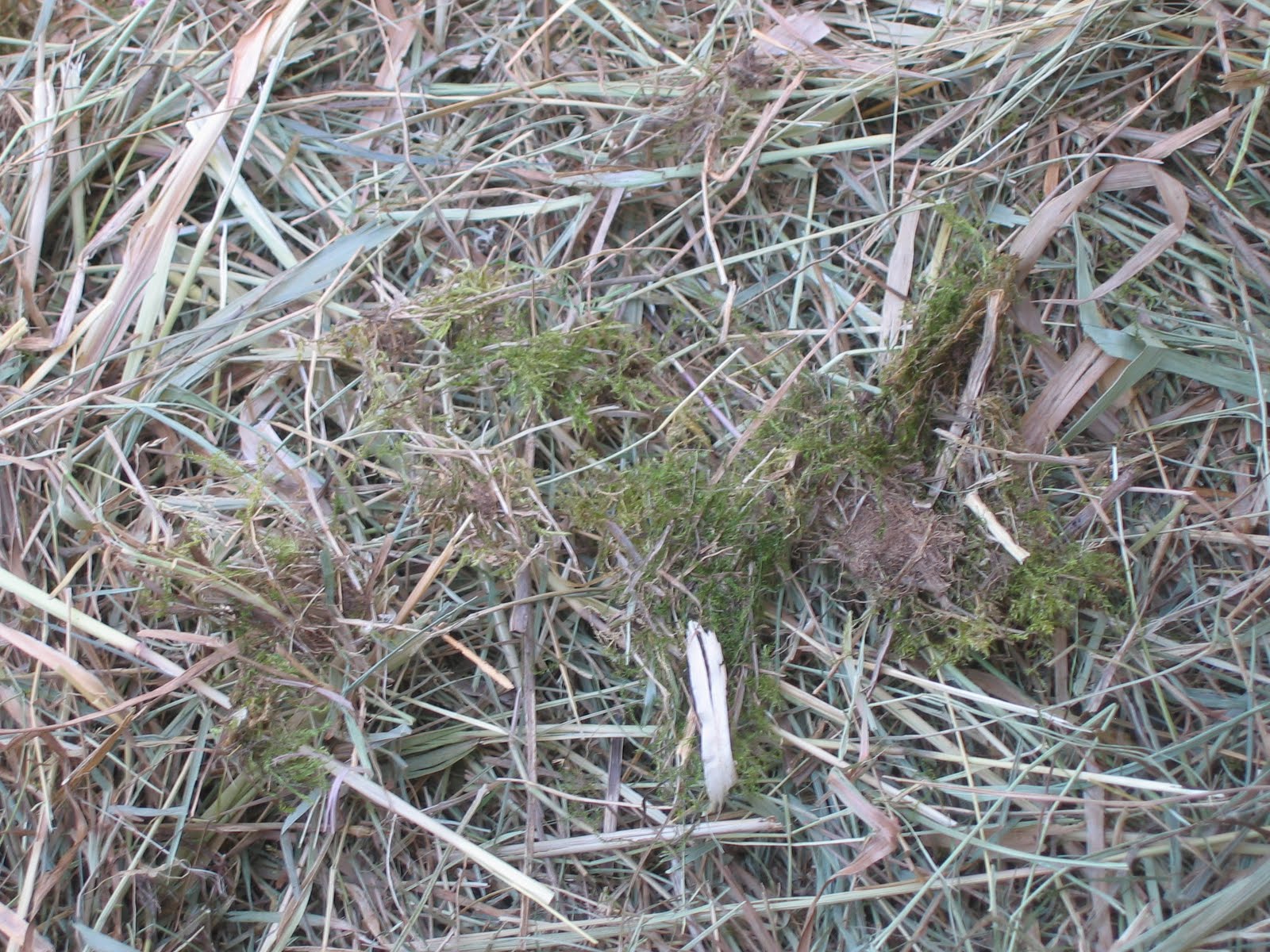 |
| Vancouver Island Hay 2011 - see all the moss? Could mean the hay was grown in acidic soil, possibly stressed as I know it wasn't fertilized, so it could be higher in fructans! just a guess ... |
After sifting through my 5 sample bales, I chose 1 and sent a sample of strands pulled from inside and outside, to the lab. If the results are what I'm looking for, then I'll buy 100 bales and will be able to recommend this as "good donkey hay" to others in the area. If the results are wrong for us, then it will be back to the drawing board and the search will have to continue.
In the meantime, I have been soaking hay for both Siog and Dorica for over a week now - so far ... perfect poop! So this may indeed have been Siog's problem.
 |
| This is hay from last year that I thought I'd consider instead of feeding straw this winter. When I opened the bale, I see that it is almost 100% canary reed grass - not a bad thing in a mix of grasses but I wouldn't want to feed it by itself. One thing you can test for: if you twist a handful of hay, it should shatter. If it makes a rope instead, this could happen in the donkey's belly and cause colic - not good! This bale will go into my garden as mulch! |
Shopping for the right Hay!
Nutrition is such an important key to good health but it's often not until something goes wrong that we think about it seriously. While we might think of offering donkeys a mineral or salt block, maybe some treats or supplements sometimes, we give them plenty of hay. And, hay is "hay" ... right?
Wrong!
Although I have been sending off samples of hay to be tested for protein levels every other year, I have now delved ever more deeply into the variations on hay in an attempt to find the perfect hay for donkeys.
The first year we had donkeys (2002) I followed the lead of a friend and bought hay from the same supplier that she did. She was feeding horses though and I soon learned that this beautiful horse hay was far too rich for my donkeys. What does "too rich" mean? Donkeys need protein levels in hay to be around 5% and this hay was 12%! Back then, I don't think many people were even thinking about sugars in hay ... more on that dreaded component later.
Back to hay - ever since Siog arrived, 9 months ago, she's had intermittent diarrhea and this has been of great concern to me.
I've carefully dewormed her, had an equine panel done to see if she has a bacterial infection (no, thank goodness!) had her teeth floated, given her probiotics and Ulcerex and Bio-sponge ... nothing has helped!
Next I was reluctantly considering acupuncture and Chinese herbs! Reluctantly because a) that's expensive treatment and b) I prefer to keep things as close to "natural" and uncomplicated as possible!
But as luck would have it, an equine nutritionist suggested that Siog is probably suffering from a fructan overload! Too much sugar in the hay and straw! Oh boy - a possible diagnosis and not that hard to fix!
So this is what has led me on the path to learn as much as I can about hay.
Wrong!
Although I have been sending off samples of hay to be tested for protein levels every other year, I have now delved ever more deeply into the variations on hay in an attempt to find the perfect hay for donkeys.
The first year we had donkeys (2002) I followed the lead of a friend and bought hay from the same supplier that she did. She was feeding horses though and I soon learned that this beautiful horse hay was far too rich for my donkeys. What does "too rich" mean? Donkeys need protein levels in hay to be around 5% and this hay was 12%! Back then, I don't think many people were even thinking about sugars in hay ... more on that dreaded component later.
Back to hay - ever since Siog arrived, 9 months ago, she's had intermittent diarrhea and this has been of great concern to me.
I've carefully dewormed her, had an equine panel done to see if she has a bacterial infection (no, thank goodness!) had her teeth floated, given her probiotics and Ulcerex and Bio-sponge ... nothing has helped!
Next I was reluctantly considering acupuncture and Chinese herbs! Reluctantly because a) that's expensive treatment and b) I prefer to keep things as close to "natural" and uncomplicated as possible!
But as luck would have it, an equine nutritionist suggested that Siog is probably suffering from a fructan overload! Too much sugar in the hay and straw! Oh boy - a possible diagnosis and not that hard to fix!
So this is what has led me on the path to learn as much as I can about hay.
Subscribe to:
Posts (Atom)